Showing posts with label Now Serving. Show all posts

Wednesday, March 30, 2011

Brooding Over Butternut

I have spent so long trying to find another good poem about orange or about squash that I probably could have written my own in less time.  But I did finally find a marvelous one for today's All About Orange installment of Now Serving: Bidding Butternut Bonne Nuit.

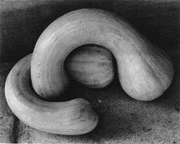
First, the poem.  Which is actually part of an art installment and it goes with the picture below, neither of which is my own:


Conversation - Poem on Edward Weston's "Squash" (commissioned for a centennial project of the Yale Art Gallery)


"Delve for me, delve down, delve past your body, crowned
by its hidden stem, into shadowy alarm;
you will not vanish past our dark-shed charm,
throat over throat, ankle to ankle, bound
in our different arches, summer-nicked and browned
interlocking rings in the chain of wrist and arm."

"Lie for me, lie, and I will feel you turn.
Mark out the summer's bending time. Yes, learn
to cradle the concrete ground to softness.  Stay.
Measure me past my stem, though your shadows churn;
Close yourself over; encompass me like clay."

-Annie Finch (2000)


Sigh.  I wish i could write like that.  But I am not a poet, I am a painter (ha ha).  And sometimes, a cook.  And sometimes, I paint with food.

Monday, January 31, 2011

BC3: Le Jour de Gloire est Arrivé

Originally, I had half a mind to spread out the Bear Claw Trilogy across several months, and maybe even tint the photos in an homage to Kieslowski, but feared that in the end, no one would remember the prior installments, thus losing whatever tiny shred of anticipation or interest you may have in knowing the outcome of my pastry travails.  I also discovered that as far as a tool for allegorical narratives on liberty, equality, or fraternity, danish pastry just doesn't provide much to work with (The Addition, on the other hand, is like all your favorite trilogies and Freudian analyses wrapped into one (various contractors playing the Godfather, the bank as Sauron, the architect as The Architect/deus ex machina, the house as symbol for repressed emotions, etc.)

So grab some popcorn and a comfy seat for Bear Claws 3: The Viking Uprising


Sunday, January 30, 2011

Bear Claws, Parts 2: Revenge of the Grizzly

So, when we last left our heroine, she was wallowing in the mauling she received from the bear claws she had spent two days making from scratch.  She nursed her wounds over the next few weeks and, finally, after the pain of epic culinary failure subsided and the pendulum of time swung to her side, the fire of revenge lit within her breast as she stared at the other half of danish dough, which had heretofore been mocking her every time she opened the freezer.  Determination swelled as she flung the frozen dough onto the counter and vowed that this time, she would conquer the bear.  She envisioned licking almond crumbs and flaky pastry off her fingers as the dough thawed into battle position.

Not to be fooled twice, our heroine prepared for the long campaign ahead of her.  Like any good coach after an embarrassing loss, she reviewed the film footage of the prior game, jotting mental notes of weaknesses in her position; she reviewed the texts, poring over the instructions for cues she had missed.  In the end it was fairly clear that defeat had come during the proofing process.  Berenbaum's recipe for the Bear Claws had said that the claws should be set to rise "in a warm place."  So our heroine had slightly heated up the stove, let it cool a bit (as one might for baking bread) and put the pastry inside to rise.  Having returned to the master recipe for danish dough, Berenbaum elaborated considerably on the particularities of the proofing process, namely that one should proof the dough at a temperature between 86 and 92 degrees, which the author achieved through ridiculous measures involving ramekins full of hot water to support a second jelly roll pan to cover the first, topped with a heating pad.  Having no second jelly roll pan, and no desire to retrieve the somewhat buried heating pad, our heroine decided to heat the convection microwave to 100 degrees, let it cool for 10 minutes, and proof the bear claws in there.

The second weak point in her prior assault had been the filling.  The remonce recipe in Beranbaum's book was somewhat runny to begin with.  In re-reading the text, she also realized that she was supposed to use half of the amount produced for the bear claw recipe.  Overstuffing the bear claws with semi-gelatinous almond filling had clearly contributed to the downfall of the danish.  Our heroine determined that this time, she would also refrigerate the remonce so as to prevent the butter from melting during the proofing process.

And so, having charted her course, she returned with great courage to the site of her ignoble defeat, gave the cry of battle and gently attacked the dough with her rolling pin.  She rolled, she cut, she filled, she sprinkled with cinnamon sugar, she brushed with eggwash, sealed, folded, sliced, brushed with eggwash again, and sprinkled the nascent claws with sliced almonds.  Then she put them in the just slightly warm box of the microwave and let them rise for the allotted time, whereupon, they looked like this:
This was a vast improvement over the prior batch; however, while not as visible from the film footage, our heroine was again facing creeping pools of butter and remonce leaching from the claws.  She held her head up defiantly as she cast them into the fire for 15 minutes until golden, whereupon they looked like this: 
The claws glistened in the light and she wasn't yet sure what to think, so set the kettle to boil and went about making a pot of chai tea, gathering her hand-me-down New Yorker, and cautiously preparing for the first bite.  The fruit of her arduous labors looked promising enough:
She bit into the claw and chewed thoughtfully while gazing upon the falling snow.  Outsiders declared success, but she hung her head in shame.  Store-bought bear claws would be better than these flaccid, flavorless pastries.  The almond filling had evaporated into the dough, which was too chewy, too dense, and tasted primarily of unsalted butter.  It wasn't worth finishing.  End game:  Bears 2; Vikings 0.

Friday, January 28, 2011

A Danish Tragedy


Before i begin the tale of The Girl Who Wrestled the Grizzly Bear (and Lost, Twice), i'd like to issue an open invitation for blog post subjects.  I am currently enjoying an unknown quantity of time off while i wait for my new fellowship to start (probably a few more days, maybe a week), and so am planning to make up for my future lack of posts once i start fixing the US budget and tax code with more posts now.  I had initially thought that i could just write a couple of really long posts - i was going for a sort of New Yorker main article thing, especially in light of how rarely i seem to write - but after having heard several complaints about the length of A Certain Slant of Light, promise to scale back to fit the more hurried mind/enable you to finish reading before the boss comes back and sees you aren't working.

I'm tentatively seeing if i can manage a post a day - the snow is helping - but make no promises.  But i'd like to know what you'd like to hear about - i know this started as a Home Disaster blog, but wandered into Home Disasters and Food Successes territory (today brings the union of the two), and then it just became Whatever Random Thought and/or Poem/Song/Book/Piece of Art/Favorite Architecture/Political Issue du Jour Is in My Head blog.  Here are some subjects i've been pondering (or have already started drafts of months ago):  a history of modern architecture, why is pretty furniture overpriced, the tiling of the fireplace hearth, the new kitchen pantry and all things orange, photos and stories from the San Juan Islands or Barcelona, and recipes (with obligatory historical investigation) for chicken pot pie, meatloaf and baked grits, apple and pumpkin pie, and revenge of the Danish.  But i'm happy to take on anything you've been curious about but not obsessed enough to research to death and write a blog post about.  So go on, don't be shy - submit a comment (even anonymously)!

Bear Claws, The History
This post actually started when my MIL came to visit last summer bearing a box of freshly-baked bear claws from the fabulous Amish bakers in Lancaster County, PA.  I adore bear claws, and these were especially delicious ones with fluffy layers of cinnamony pastry and drizzled with glaze.  I normally never ever ever buy them because i know that the caloric content is roughly equivalent to one's weekly allowance.  But if one doesn't actually purchase them, they have fewer calories. These were so good that i actually wanted to eat the crumbs:
But eating the crumbs seemed slightly uncouth, and i didn't want anyone to walk in on me with my face in the box, looking like a horse with a feedbag strapped on or the kid brother showing mommy how the piggies eat in A Christmas Story.  Then i had sudden inspiration to use them as a mix-in for a batch of ice cream - a far more elevated approach to wasting not.  So i made a batch of almond ice cream and mixed in the bear claw crumbs, creating what would be my new signature flavor, Grizzlies on Ice:

Then i decided to add this to Now Serving, but thought it would be an even better post if i made bear claws from scratch first.  And then, i got the new iMac and was playing around with iMovie and iThought:  "Oooo, iCould make a stop-motion iMovie about the making of the bear claws!"  And so, iSet up my camera on a tripod and took hundreds of photos of the mixing of the dough, the rolling of the dough (4x), the cutting of the dough, the filling the dough, the forming into claws, the raising of the claws, which is when iNoticed that things were starting to go awry.  But iPersevered and baked the bear claws and made the iMovie, which will be presented shortly.

But first, a quick history on danish pastry:

1) It's not actually Danish.  This sweet, laminated pastry was brought to Denmark by Viennese bakers who were brought to Denmark when the native bakers went on strike in 1850, demanding wages in cash instead of in food and lodging.  The Viennese didn't know how to make traditional Danish breads, so did their own thing.  This is why the Danes (and everyone else in Scandinavia) actually call danishes wienerbrød or "Viennese bread" (also the meaning of "viennoiserie," as the French call them.)  The Viennese, for their part, call it "golatschen," which is interesting in that i grew up in Nebraska calling them kolaches, which is what the rather sizable Czech/Bohemian community there calls them.  Anyway, it's not a total lie to call them Danish; when the Danish bakers went  back to work, they picked up the laminated technique, but added eggs and more fat, as well as almond filling, jams, chocolate, nuts, etc.

2) In Denmark, the bear claw (or cockscomb, as it's called in most of Europe) is the most popular shape of danish.

Just so you know, i could go on, but I'm trying this new Keep It Short Thing.

Bear Claws, The Recipe
I decided to try out the bear claw recipe in my new copy of the Pie and Pastry Bible by Rose Levy Beranbaum.  In the interest of time, i will not retype it for you here.  If you want to follow a set of instructions that makes Martha Stewart look like Rachel Ray, you can print out a copy of the recipe yourself from here.  But here's the general gist of things:
1) Proof some yeast and warm milk.
2) Mix the risen yeast with some flour, sugar, salt, cardamom, egg, and a little butter.  Let the mixture sit for 30 minutes.  Deflate and then refrigerate the dough for 2 hours.
3) Make a butter square with a boatload of butter and a little flour.  This part's fun.
4) Roll the dough into an 8" square, then add the butter square, encase the butter square with the dough.
5) Roll/fold the dough.  Chill.
6) Roll/fold the dough. Divide dough in two.  Chill/freeze.
7) Make the filling.
8) Shape the danish by rolling the dough, cutting the dough into squares, filling the squares with filling (i added a cinnamon sugar sprinkle), closing up the squares, slicing the "claws," brushing with egg wash, sprinkling with almonds, and curving into the bear claw shape.
9) Proof the bear claws.  The bear claw recipe only makes the vaguest reference to how to proof the danish, which is found in detail at the master recipe, and essentially requires several complicated steps and a constant temperature of 86-92 degrees.
10)  Bake the bear claws.
11) Eat the bear claws.

Bear Claws, The iMovie
Here it is, my first ever film:


As forewarned, it's film noir.  The bear claws began to ooze butter as they rose; despite my attempts to mop up the butter, they positively hemorrhaged butter once in the stove.  The end result was more akin to fried bear claws, and not in a yummy British chip shop or Texas State Fair kinda way.  I thought about rewriting my little film with a happy ending and then thought:  Everyone's food blog shows their glowing successes, closeups on their beautifully-arranged dishes, the lighting just so. But how many people show you their abject failures, besides me?  And isn't tragicomedy really the story of this blog/my life?

Anyway, submit your own guesses as to what happened and why along with your ideas for future posts!  And stay tuned for Bear Claws, Part 2:  The Wrath of the Grizzly, along with the critic's film review and cooking analysis.

Saturday, January 1, 2011

Le Boeuf et la Bûche

Well, another roller coaster year has pulled into the station at the end of the ride.  While i cannot personally remember a worse December, there were also some lovely highlights of the year, which - as always - centered around friends, family, and food.  So to close 2010, i'm going to share with you two of my favorite recipes, the making and sharing of which have become time-honored annual rituals of near-religious proportions and define the term "comfort food" for me.  Of course, like all comfort foods, especially French ones, boeuf bourgignon and bûche de noël are labor intensive to make, but for me, a large part of the "comfort" aspect is achieved from the therapeutic effect of losing myself in the culinary process.

Bœuf Bourgignon

Of the two traditions, the newer one (of five or six years) is serving bœuf bourgignon on New Year's Eve.  This is hands down my favorite French dish - a popular pick akin, i suppose, to loving apple pie as a favorite American dish.  My mother would make it on the rare occasion when i was growing up, but i don't know that it was really a favorite of hers and in any case, i don't remember rhapsodizing about it until i first had it in 1992 at La Crèmerie-Restaurant Polidor in Paris.  Le Polidor is a pretty famous spot and was a favorite of James Joyce and Jack Kerouac, as well as me (but this particular fact is not mentioned in the guidebooks); it's tucked away on a tiny side street in the latin quarter, identifiable primarily by the line of people waiting to get in for some of the best (and certainly most reasonably priced) traditional French cuisine in Paris.  The tables are pretty much all communal, which is one of the things i actually adore about it, but which has freaked out American friends or family who are used to having acres of space and so-called privacy.  What i find interesting about such preconceptions of "privacy" is that i have generally found that when dining in Europe, despite being necessarily packed in like a sardine, one is rarely subjected to the forced eavesdropping that occurs routinely in the States coming from that deafeningly loud group five tables away that just can't help but share with the entire restaurant the hilarity of their incredibly inane antics.  I attribute this difference to the loss here in the U.S. of a fine tradition we, too, once had, referred to as "manners," "discretion," and "consideration for others" - or more simply put among some parents I have had occasion to overhear:  "indoor voices" (mourning the loss of this tradition is referred to as "being a total curmudgeon").

Anyway, back to le bœuf.  The origins of bœuf bourgignon (originally, bœuf à la bourgignonne, aka beef burgundy) aren't that mysterious - it's a peasant dish that came about when some enterprising Burgundian marinated what was likely some pretty tough/nearly inedible beef in a decent local vintage and a bouquet garni, some carrots, and garlic for a day or two, then added a bit of bacon, boiled the whole thing down into a tasty stew, and tossed in some little onions and mushrooms at the end.  Interestingly, despite being elevated to haute cuisine, first by Auguste Escoffier (chef of the original Ritz in Paris, and referred to as "the Emperor of Chefs" by Kaiser Wilhelm II), and later internationalized by Julia Child, the ingredients and the process for making beef burgundy haven't really changed all that much.  Maybe that's part of the notion of classic comfort foods - the depths and simplicity of the original combine into a culinary essential truth that withstands the harsh tests of time, such that it is no longer just that the dish itself is satisfying, but its essential underlying perfection also provides emotional solace.  To go overboard with the analogy, maybe comfort foods are like little stepping stones in the ever-changing river of our daily lives.

Monday, December 13, 2010

You've Stollen My Heart


As i've mentioned already, winter is my least favorite time of year, and this week's freezing rain and frigid temperatures have done nothing to lift my spirits.  I also must confess to having a bit of a bah humbug attitude toward the holidays, for which i blame the American retailers who have been torturing me with Christmas carols since Halloween.  It's hard to actually get excited about the holidays when you've been bombarded with exhortations to empty your wallet on inflatable yard ornaments and other useless items in the name of Jesus for a quarter of the year.  This is probably why i always end up doing my holiday shopping at the last possible moment:  i become so inured to the season that i end up forgetting how close Christmas is until about December 20th, which has been really good for all the overnight delivery companies.

However, all is not gloomy here, as i am never more prolific in the kitchen than during these short days and freezing nights.  Since i cannot skip down the slippery sidewalks, i bask in the glow of a warm stove.  To counter American consumerism run amok, i tend to take on the most arduous and intricate culinary adventures, and send to friends and family boxes of handmade chocolates and Jackson Pollack-painted gingerbread men.  Truth be told, about now, the kitchen is usually covered in cocoa, there are smudges of chocolate on the refrigerator door, and there is powdered sugar and flour dusted over most surfaces as i race to finish the 8th kind of cookie so we can get them boxed up and out the door.  Every year i've been upping the ante on difficulty, and last year this meant delving into the Culinary Institute of America's textbook tome on chocolate making, the end result of which was that in addition to the 8 kinds of cookies, there were grand marnier truffles and raspberry ganache filled chocolates made in a polycarbonate mold and dusted with edible ruby pixie dust.  

Tuesday, August 25, 2009

Round One: Paris Saint-Germain vs. The Eagles, a.k.a. Football vs. Football a.k.a. Glace Vanille vs. Vanilla Ice Cream


Welcome to the inaugural episode of Now Serving! Our culinary adventure begins with the Lello the Magic Gelato Machine, a long-awaited arrival to brighten my little kitchen nest. Lello arrived on July 29 at 4pm, at a hefty 33 pounds. The first thing I did was ring in my 38th year at 12:02 am with a batch of blackberry sorbet. It was tasty, but just as an education in cooking starts with learning how to make eggs in every fashion, I've decided to learn my future profession from the ground up, starting with the mailroom of the iced desserts world: vanilla ice cream.

Ice Cream: The Abridged History

Like every favorite food, from pizza to pasta, ice cream has a highly contested history whose cast involves the usual suspects: China, Italy, France, the US, with Persia as the unknown starlet who steals the scene.

Larousse Gastronomique commences its historical tour de glace with the keenly astute observation that "the history of ice cream is linked with that of gastronomy and refrigeration." It goes on to credit the Chinese with knowing "the art of making iced drinks and desserts long before the Christian era." This art, the Chinese supposedly taught to "the Arabs, who began making syrups chilled with snow, called sharbets (hence the word 'sherbet' and 'sorbet.') At the court of Alexander the Great, and later under Nero, fruit salads and purees were served mixed with honey and snow. It was not until the 13th century, however, that Marco Polo is said to have brought back from the East the secret of cooling without ice, by running a mixture of water and saltpetre over containers filled with the substance to be cooled. Thus the great fashion of water ices began in Italy." The Gastronomic Committee at Larousse then goes on to credit Catherine de Medici with bringing this technology to the French court when she wed Henri II, but that this culinary novelty was not discovered by the Parisian hoi polloi until Francesco Procopio opened his famous Cafe Le Procope there a century later. Although ices made with milk, cream, and eggs appeared on the scene around 1775, this technique had apparently been discovered in 1650 by a French cook (mais bien sur!) in Charles I's English court, but had been paid by the king to keep his method a secret.

In any case, Larousse essentially gives the French and Italian chefs credit for all advances in the field until 1822, with the creation of such flavors as: "Malmsey wine from Alicante, angelica liqueur, the yolks of finch eggs, sugary melon, hazelnuts and mint liqueur, green tea and citron juice, pistachios and peach juice." However, the US is given its due for taking the ball and running with it in the 20th century, with "itinerant ice-cream vendors ... selling in the streets;" Larousse notes that the US "has been particularly creative, inventing myriad new flavours and ways of eating ice cream, including sundaes..., sodas..., milk shakes..., malts...and pie a la mode (pie with a scoop of ice cream)." I think it's hilarious that they translated pie a la mode.

For me, the Larousse is, as Jacques Pepin is quoted on the flap as saying, "the first place I look when I need to clarify a cooking question." Due to my own knowledge of French views on cooking, however, it is rarely the only place I look if I am concerned about historical accuracy and, surtout, impartiality. The tip off here was the egregious error in ascribing the Persian place in ice-cream making (taking place, according to Larousse, prior to Alexander the Great) to the Arabs, who did not conquer Persia until 900 years after Alexander's death around 323 B.C.

In any case, there is an excellent unabridged history of ice cream, with appropriate source citations, at The Nibble, and What's Cooking America but the key dates are:

4,000 B.C.: Chinese master the art of frozen desserts, including the key discovery that using salt and cool water/ice on the outside of a container lowers the freezing point of the contents inside the container. [Ed. Note: It has been brought to my attention that this is an inaccurate description of the science behind the method, but it's too long to explain here - stay tuned for a post on why ice+salt is necessary to make the ice cream freeze. In short, it lowers the temperature of the ice/liquid outside the canister, enabling the contents to freeze. Don't think too much about this or your head will hurt. Just trust me on this.]
2,500 B.C.: Persians, whose empire borders China, learn these nifty tricks. They are renowned for drinking fruit syrups cooled with ice (sharbat), a proto-Sno Cone of fruit ices sweetened with honey and cooled with snow. In a "you got your chocolate in my peanut butter moment," they also cross two favorite desserts - sorbet and rice pudding - into a dessert called faludeh around 400 B.C. - a delicious concoction of milk and vermicelli still served today and featuring rose water, saffron, lemon, and dried fruits.
300's B.C.:Alexander loves Persian snowcones so much, he has slaves climb mountains and bring down snow and store it in 30 foot deep trenches to ensure that his troops can enjoy their sharbat during battle, helping to eventually secure victory over the Persians after 10 years of war.
50 BC: Nero, the copycat, does what Alexander did, but makes his slaves run up and down the mountains for his snow.
700 AD: Arabs conquer Italy, bringing sorbet and pasta, which they acquired from their conquest of Persia 100 years earlier. Italians make granita, the much chunkier, and easier-to-make version of sorbet and commence securing their place in ice cream history.
1500s: Renaissance starts and while royalty dined on iced desserts, there is in fact no support whatsoever for the stories regarding Catherine de Medici (who was a mere 14 year old at the time of her marriage) nor Charles I's chef having invented ice cream.
1660 - 1690: - first recipes for flavored ices appear in French cookbooks and Starbucks-precursor Le Procope opens, serving coffee (of which Voltaire is said to have drunk 40 cups per day) and some sort of frozen dessert -whether sorbet or true ice cream, seems in dispute - to wealthy Parisians and later to Ben Franklin and Thomas Jefferson. You can have it too, if you want - Le Procope is still open and still a Parisian highlight.
1744: A group of Virginia commissioners dine at the Maryland Governor's home, where they are served "a Dessert no less Curious; Among the Rarities of which it was Compos'd, was some fine Ice Cream which, with the Strawberries and Milk, eat most Deliciously."
1769: Elizabeth Raffold's The Experienced English Housekeeper includes a recipe for what looks like ice cream to me.
1770 - First U.S. gelateria opens in New York.
1777 - Philip Lenzi advertises in the New York Gazette that his business has ice cream available almost every day.
1802: Thomas Jefferson serves ice cream at a state dinner. He also writes his own recipe for vanilla ice cream, available for view on line here or in person (apparently) at the Library of Congress (I feel a subsequent episode coming along, perhaps with assistance from my dear friend and fellow foodie, Hannah).
1813 - Sallie Shadd, a freed slave, claims to have invented ice cream made of fruit, cream, and sugar, in Wilmington, Delaware. Dolly Madison travels to taste this new specialty and loves it so much that she serves it as the dessert at her husband's second inauguration, and at all state dinners thereafter.
1834 - Augustus Jackson devises the first modern method of manufacturing ice cream using ice and salt (per the Chinese method) to make ice cream in tin cans. After quitting as White House chef, he sells his ice cream to Philadelphia ice cream parlors. Augustus is African American and, as usual, some white person gets the patent and most of the credit.
1843 - Nancy Johnson receives first patent for the hand-crank ice cream maker, not unlike the same version sold by White Mountain today, enabling everyone to get their kids to crank that sucker for 45 minutes on hot summer evenings, with the end result that most pleasurable of childhood memories: homemade ice cream. I can still taste the eau de rock salt, and I say that fondly.
1851 - Jacob Fussell, a Baltimore milk dealer, has so much milk that to keep it from going sour and to expand his clientele, he starts manufacturing ice cream on an larger scale, and is credited with being the father of commercial ice cream production.
1865
- Term "hokey-pokey" enters the lexicon due to explosion of Italian ice-cream vendors on U.S. streets after the Civil War. Term itself is likely a corruption of "ecco un poco" (here's a little) or "O, che poco!" (oh how little) - presumably a reference to the price of the product.
1926 - Invention of continuous process freezer leads to the birth of the industrialization of ice cream production.

Whew! And there is so much more to learn, especially at Linda Stradley's What's Cooking America website.

The City of Lights vs. The City of Brotherly Love: Ice Cream Styles 101

So why the title of this post? As the history above hints at, modern ice cream really has its roots in Italy and France but its heart in America. Paris is where ice cream was first made fashionable, but Philly is where it became the Brangelina of the dessert world. One of the first differences that crops up when you start reading about making ice cream is the major dividing line between what is now called either French style ice cream or frozen custard vs. Philadelphia style ice cream (no alias), or as is seen on display in the ice cream case: French vanilla vs. Vanilla.

These two items are not dissimilar from football in France (aka soccer) vs. football in the U.S. in that both involve similar ingredients. In soccer vs. football, both have a field, two teams of about the same size, and a ball - and similar rules - your team has one side of the field, your opponent the other, and to score, you must get the ball across the furthest line on the opponent's side of the field. It is how one scores that differentiates the two games - one is primarily done with the feet; the other with the hands. Paris Saint-Germain vs. the Eagles. And oh what a difference is found in the "how."

French and Philadelphia style ice creams are much the same in that they both have a base of milk, cream, sugar, and some sort of flavor or fruit, you're heating it up to dissolve the sugar, then cooling it down and churning it all the while to prevent it from freezing solid or crystallizing. The difference between them really comes down to one thing: French vanilla has eggs; Philadelphia vanilla does not. So if you wondered why French vanilla looks yellow and regular vanilla looks white, that's the difference. Like soccer, eggs impart a magical sophistication, skill, and depth to cooking that is hard to imitate. Eggs bind, they emulsify, they stabilize, they add depth, they are the magical shape-shifters of the culinary universe. Eggs are ridiculously talented. And when blended into an ice cream base, they act as an emulsifier and a stabilizer for the fat from the cream and the milk. They also add a richness to the flavor. Ice cream without eggs is an act of brute force, much like the Eagles' running game. You're forcing the fat to freeze and you're churning it to keep it from crystallizing, but the fat never really binds to the water of the concoction, and the moment the heat hits that puppy turns to a milk shake. On the other hand, like many French dishes, French-style ice cream is dense and rich and it can overwhelm delicate flavors. There is nothing so all-American as Philadelphia-style strawberry ice cream on a hot summer's day - it's sweet frothiness is the perfect end to a dinner of grilled burgers and corn on the cob.

In saying this, I have in some ways told you the ending of the story. But like all sports, there is joy in the playing, regardless of who wins the game. And so begins our first match: The Thrilla of Vanilla.

You Say Vanille...

I have chosen The Perfect Scoop, by David Lebovitz, as my initial guide into the world of ice cream making, along with the Lello instruction manual and recipe booklet. He has a head-to-head recipe of French vanilla vs. Philadelphia style vanilla which are the basis for this first episode of Now Serving. First up, French or custard-style ice cream or glace vanille.

The ingredients are simple: 1 cup whole milk, 3/4 c. sugar, 2 c. cream, pinch salt, 1 vanilla bean, 6 egg yolks (6!!), and 3/4 tsp. vanilla extract.
Quality out depends 100% on quality in, in my experience, so I shuffled off to the organic market for the freshest, least-doctored dairy products I could find, from Trickling Springs Creamery in Chambersburg, PA. Yep, those are glass bottles, which they swear makes it taste better (I agree) and they also adhere to the first principle of environmental conservation: rinse and reuse. I haven't seen these since I was a kid visiting my grandparents in Wahoo, who still got daily deliveries from the Roberts Dairy milkman. The milk box was a standard component of my front porch games. Anyway, there you have it: the components of my glace vanille.

Step One of any ice cream is to heat the milk and some of the cream with the sugar and salt until the sugar dissolves. Then add the vanilla bean (scrape out the seeds first, then add the seeds and the pod) and let it steep, covered for 30 minutes. It looks like this:

Now comes the tricky part: making the custard. It's like riding a bike though. Figure it out - including falling down once - and you've got it forevermore. In Lebovitz' version, 1 c. of the cream and the extract have been reserved to receive the custard - I put them in a stainless steel bowl. Whisk the egg yolks in a measuring cup (you can freeze the whites for use in other things) and add about a cup of the steeped vanilla mixture (should still be warm, take out the bean) to the eggs, whisking while you work. Once mixed, pour the eggy vanilla mixture back into the remaining milk/cream mixture in the pot and turn the heat back on (low-medium) and stir constantly. A spatula helps reach every corner of the pot, but isn't necessary. What you're looking for is that moment when the liquid turns slightly solid and coats the back of a spatula such that you can run your finger down it and the divide remains (Lebovitz says this happens around 170-175, but it was closer to 180 for me). Do not overcook or you will end up with a separated eggy concoction which, fortunately, you can reconstitute if you work fast, by sticking it in the blender on high.


See the finger line down the spatula? Ta-da: custard!! Once you have your custard base, you now need to cool it, pronto. This is done by pouring the custard in the stainless or other non-reactive bowl (metals just transfer cold faster) with the remaining cream, putting it in an ice bath, and stirring constantly until the mixture feels cold. You can tell this is the case if the bowl itself (above the mixture) starts to feel cold.

Once cooled, pour the base into a container and put it in the refrigerator for several hours or overnight until thoroughly chilled. Then pour it into your mixer and freeze according to directions. Lello took about 45 minutes to reach this consistency:


...I Say Vanilla

Take 2. Now we've got 2 c. cream, 1 c. milk, 3/4 c. sugar, pinch salt, 1 vanilla bean, and 3/4 tsp. vanilla extract: Same general idea: Heat 1 c. of cream with the sugar, the vanilla bean and its seeds, and heat on medium until the sugar is dissolved. Remove from the heat and add remaining ingredients, stir, and put into container and chill the mixture until cold. Then process according to your machine's instructions.

In the end, here are our contenders, scooped out of their plastic containers after a night in the freezer, and displayed side by side:

Can you guess which is which? It's pretty easy: Philadelphia style is on the left; French vanilla is on the right. As one might predict the Philadelphia style version was much lighter and closer in taste to the memories I had of hand-cranked ice cream - fresh milk and sugar with the perfume of vanilla dancing on the palate. However, to my surprise, this version has a slightly waxy mouthfeel to it, the cause for which will be explored in future episodes, but in short comes down to the fact that I was using unhomogenized dairy products. I think.

The French style vanilla was superb. It was rich, very vanilla-y, and had a luxurious mouthfeel with no waxy sensation. It also held its shape better and didn't melt as rapidly. Because of the eggs, the vanilla was a bit more muted, but overall the glace vanille won the battle, edging its Philadelphia brother out on the basis of texture.

Well, I hope you've enjoyed the show and will come back for our next installment of Now Serving. If you try this, let me know how it went for you and whether you had similar results. Cheers!
Monday, August 10, 2009

Now Serving

I'm a sucker for the subplot, the twist, the undertow, the show-within-the-show. As I am sure several of my posts have already exhibited, I tend to wander off the main storyline into TangentLand fairly frequently. I'd like to think that this is due to my own interest in the behind-the-scenes action, but it's more likely a product of my poor storytelling skills and lack of focus.

Yet it strikes me, especially of late, that the main story of Hausaufgoblin can kind of feel...unoriginal...in its plot. Hapless Homeowners With Good Hearts Naively Get Suckered By Evil Greedy Contractors is a story with a Dickensian formula that, while I hope is well-written on better days, is also perhaps as formulaic as American Political Masterpiece Theater: Tonight's Episode - Naive Obama Twist tries to save us from impending health care doom, but will this good cause be cruelly sabotaged at the hands of the conniving Rush Limbaughburgerbottom who seeks to take us all down just to ensure Obama Twist doesn't succeed? Stay tuned!! And I hope you do stay tuned for the occasional bon mot, the rare elegant turn of phrase, or perhaps just to remind yourselves why renting is better. However, I think the time has come to add an unexpected twist in this tired old plot.

So, to keep things lively, my new blog-within-the-blog will feature culinary escapades called "Now Serving." It'll be surprising, informative, adventurous, and most importantly will not involve whining of any sort! And check out the cool button on the side (created by my fabulous spouse) that will enable you, dear reader, to go straight to this and all future episodes of Now Serving with a single click. Season 1 of Now Serving features my current muse: Lello the Birthday Gelato Machine. It's the gift that keeps on giving. Here's a trailer for the first episode: Eagles vs. L'OM/Football vs. Football/Vanilla vs. Vanille